
Luke 6 (Gjest)
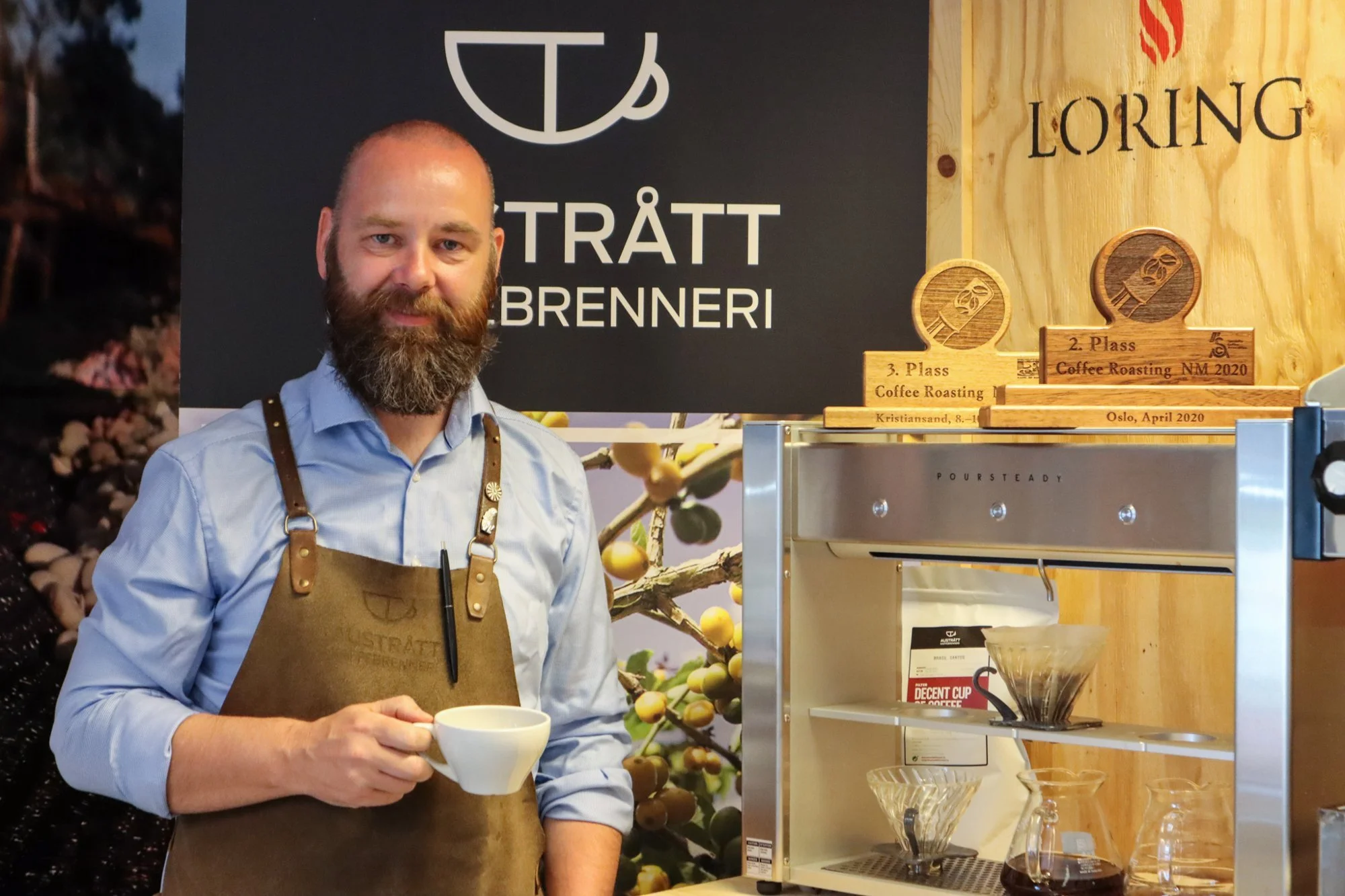
Austrått Kaffebrenneri is a relatively small and agile roastery with high capacity to deliver a broad range of origins, processing methods, and varieties of coffee. My approach to coffee is very scientific. Measure always. My coffees are roasted on a Loring 70 or a Loring 15. Roast profiles are being developed using a Røst L100 sample roaster.
The reason why choosing this coffee, co-fermented Juanilama is to challenge myself on new processing methods and varieties. But most important is showing the diverse range offered by skilled producers of speciality coffee.
I hope you will enjoy it as much as I enjoyed roasting it.
God jul 😊
Aquiares Estate
COUNTRY: Costa Rica
FARM/COOP/STATION: Aquiares estate
VARIETAL: Centroamericano
PROCESSING: Co-fermented with Juanilama
ALTITUDE: 1200 meters
OWNER:Diego Robelo
REGION: Turrialba
FLAVOUR NOTES: Dark chocolate, green grape, peanuts, grapefruit, hints of bubblegum and fruit candy.
ABOUT THIS COFFEE
The name Aquiares means “land between rivers” in the Huetar indigenous language, and Aquiares Estate is commonly referred to as “Aquiares Coffee and Community.” It is the largest farm in Costa Rica and home to 1,800 people. Although the farm was founded in 1890, Alfonso Robelo is the man responsible for its transformation a century later. Alfonso arrived in Costa Rica in the 1980’s seeking refuge from the civil war in Nicaragua, where he was politically active. When politics soured into violence, he fled the country to keep his family and himself safe after receiving several threats against his life. Once in Costa Rica, Alfonso began building the Aquiares community on the enchanting slopes of the Turrialba volcano, a lush area of forests, rivers, fauna, and bright flora.
Alfredo challenged the status quo, transforming the relationship between landowner and farm workers. He brought a visionary approach to Aquiares, a farm suffering from low prices and instability. Aquiares had more than 200 employee homes on the farm, but because none owned their home, there was great insecurity in the workforce. Alfonso saw this as an opportunity to strengthen the company by having people feel pride in the coffee they produce. He evolved the farm into a small town where workers purchased their own homes. Today, Aquiares remains a model of sustainable agriculture.
Nowadays Alfonso’s son, Diego, manages the farm. Under his lead, the farm has taken a fresh approach to specialty coffee and exploring the farm’s potential. Through excellent agricultural management, embracing new varieties, and experimenting with processing, Aquiares has become a trailblazer among specialty coffee producers in Costa Rica and all of Central America.
Aquiares focuses on carbon neutrality and measures its greenhouse gas emissions to calculate its carbon emissions against its offsets. An agent verified under the International Panel on Climate Change verifies these calculations and Aquiares’ carbon measurement and emissions reduction are part of Costa Rica’s Nationally Appropriate Mitigation Action. In addition to capturing carbon, the farm’s protected biological corridors have long ensured the wellbeing of local animals and plants. Aquiares also welcomes researchers from around the world to conduct agricultural and environmental studies on their land. Projects have included investigating the benefits of agroforestry on soil health and observing the diverse bird and wildlife species that thrive in an agroecological environment.
Aquiares is an example of innovation and perseverance whose benefits extend beyond the farm and workers and serve as a model for sustainable, equitable production for the broader coffee industry. The lots selected by Ally Coffee from Aquiares represent our shared commitment to sustainability, equity, and innovation.
REGION
Turrialba
The region of Turrialba is Costa Rica’s hidden coffee gem. The city of Turrialba is a modest agricultural town in the Province of Cartago, and the coffee farms spread throughout the Canton of Turrialba, from smallholder plots to the country’s largest estates, produce coffees with a range of cup profiles and interesting genetic legacies.
Turrialba is home to CATIE, the Center for Tropical Agricultural Research and Education, one of Central America’s premier crop research and development sites as well as one of Latin America’s largest living coffee tree variety collections. Along with other research institutions, CATIE helped produce many of the hybrid and selected coffee varieties now common in Costa Rica and neighboring countries.
The Turrialba Volcano is still active today—it began erupting more consistently starting in 2014—and the region’s volcanic soil is rich with nutrients. The area’s farmers grow vegetables and sugarcane as well as coffee, and landowners in the lower area raise beef cattle. Turrialba’s productive land supplies much of Costa Rica’s domestic needs and coffee prepared for export passes through the area’s private mills, which are more common here than the cooperatives organized in other cantons.

COFFEE IN COSTA RICA
PLACE IN WORLD PRODUCTION: #14
AVERAGE ANNUAL PRODUCTION:
1,230,000 (in 60kg bags)
COMMON ARABICA VARIETIES:
Typica, Caturra, Catuai, Villa Sarchi, Bourbon, Geisha,
KEY REGIONS:
Tarrazú | Central Valley | Western Valley | Tres Rios | Brunca | Guanacaste | Orosi | Turrialba
HARVEST MONTHS:
October - March
Coffee has been a central part of the Costa Rican experience since the country’s independence from Spain in 1821. At that time, the new government led a campaign to distribute free coffee seeds to citizens in order to promote coffee production as a cash crop. Costa Rica was soon exporting green coffee beans all over Central and South America.
Just two decades later, in 1843, Costa Rica sent its first shipment of green coffee beans to England. By 1860, Costa Rica was also supplying coffee to the United States. Coffee played such a big role in Costa Rican production that coffee was Costa Rica’s only export for the years starting from independence until 1890.Costa Rican coffee farmers experience significant barriers to production. Production costs in the country tend to be very high in comparison to neighboring countries. The persistent growth of the tourist industry, combined with the influx of foreign businesses bringing more money into Costa Rica, has created inflation. While inflation and the rising quality of life have had many positive benefits for Costa Ricans, rural areas have struggled to keep up with increasing land and input prices and the associated higher labor costs. As a result, Costa Rican coffee tends to be on the expensive side.
Especially because costs are higher, Costa Rican coffee producers must find other ways to stand out from all the other producing countries in the Americas. Luckily for the specialty coffee industry, Costa Rica has had great success becoming a frontrunner in quality specialty coffees and processing methods.
In areas like Tarrazú, where conditions are ideal for coffee growing, competition is even higher. In such areas, the competitive atmosphere leads many producers to invest in private micro mills, growing exotic varieties and alternative processing.
The focus Costa Rican farmers place on increased coffee quality is beneficial to both themselves and the specialty industry as whole. An atmosphere that encourages experimentation and innovation can breed any number of new or better varieties, growing techniques, processing methods, storage protocols and more.